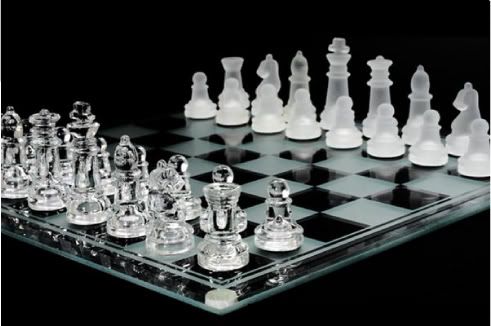
General Chess Strategy Guidelines
Useful Jargon
~"Bishop pair"= You possess two bishops and your opponent does not.
Cliffs Notes
Detailed Guidelines
Anywhere
1. Calculate the value of each piece for you and your style of play. If you use a lot of back-rank mating combinations frequently, for example, a rook might be worth 5.75 or 6 to you. If you thrive with end game and passed pawns, then a pawn could be worth as much as 2 points for you in endgame. Q=9.25
R=5.25
B= 3
N=3.25
P=1
Bishop Pair = 0.5
Grandmasters have given slightly different values to their pieces. While the rook and knight have remained constant, value fluctuations have occurred with the queen, bishop, and pawns. Modern evaluations of pawns can be as high as 1.5 in the end-game as well. Some notable alternatives:
Howard Staunton
Q=9.94
R=5.48
N=3.05
B=3.5
P=1
Bishop Pair = 0.5
or
Q=9.5
R=5.25
B= 3.25
N=3.25
P=1.25
Bishop Pair = 0.75
2. Visualize and ask Questions about your moves. Take time to visualize the board and pick the best possible move. Before performing a check or move always scrutinize the move from all angles. Ask questions such as
"What lines will open up after this move?"
"How is my development? How can I enhance it? What are my weaknesses?" Example answer: "My pawn structure is strong but I need to bring my knight to control the center."
"Will there be any discovered attacks?" "How does this move support my development, attack my opponent, and/or defend my pieces?" Example Answer: This move will support my knight's advancement to the g-file, protect my rook, and it set's up a mating skewer".
Scrutinize your opponents' moves first and play defensively, so you avoid haphazardly jumping into a messy situation.
3. Visualize and ask questions about your opponent's moves.
Good questions to ask about your opponent's moves:
"Why did he just move there?" Example answer: "He now attacks my bishop with his pawn and he bolstered his pawn structure."
"How can I setup a fork? What if my opponent's piece(s) were located there at xyz? Could I set up a fork or skewer or pin then? What's a way I could throw out some bait to get my opponent's piece(s) to fall into a trap where I exploit a tactic?
Example Answer: My opponents king is positioned such that if his rook moves to e8, I could move in with my Knight and knight-fork the king and the rook (winning the rook) so if I attack his rook with mine, he might retreat his rook to the "bait" square enabling me to pounce on the knight-fork opportunity.
"What can he do to my pieces and my development with that move?" "Was his last move great (!), typical, or a blunder (?)? Example answer: "His queen has greater mobility now. Watch out for it." or "His knight is trapped in the corner, try to capture it."
"Does he have any mate threats?" Example answer: "Yes, he's threatening a mate in two, I'll need to defend that."
"What are the weaknesses in his development and how can I exploit them?" Example answer "I have the bishop pair so I should utilize my bishops."
"Did my opponent just make a weak move?" "How can I exploit that?"
Often times with two equally matched players and no blunders, the player who can most effectively spot, understand, and exploit the opponent's "weak" or "doubtful" moves will decidedly win the game in the long run. The skill of understanding the poor or good judgment of your own possible moves and your opponents moves is a skill that's worth tremendous value. Practice these questioning and critique skills to vastly improve your game!
4. Understand and apply tactics. Know how to spot, set-up, and utilize the following:
~01 Skewers
~02 Pins
~03 Discovered Attacks
~04 Forks (especially the Knight Fork)
~05 Entrapment (the most effective is "Smothered mate")
~06 Triangulation (for endgame having the "opposition")
~07 Zchwissenzhug (the "intermediate move")
~08 Back-rank Mates
~09 Defence Destruction
5. Do not attack prematurely or without sufficient support from your pieces. Wait until you've arranged a strong attack to execute it, instead of attacking with only 1 or 2 of your pieces, have as many of your pieces as possible engaged in an attack. The center's value comes into play here because it's easy to synchronize an attack when you hold the center and have well-balanced development.
Opening
*1. Move each piece once with the goal of mobilizing all your pieces. (Ensures comprehensive development, high utilization, and tempo-loss-avoidance of pieces).
This ensures
1)comprehensive development (wholistic development of your entire piece set)
2)tempo-loss avoidance (you don't lose a tempo).
3)high utility of piece set (each piece has something to do).]
In the event that one of your pieces gets attacked in the first 6-8 moves, your opponent most likely deviated from this core guideline by moving a piece more than once and will likely have lost tempo, or have an undeveloped opening. Exploit that as much as possible. The opening should be devoted to assembling your arsenal of pieces not just one small area of the chess board. Dynamically mobilize your entire "chess troop" instead of just one or two pieces. Moving one or two pieces works best for middle game when you have the freedom of movement, flexbility, and support of all your other pieces after a solid opening game. Not developing your pieces in the opening can wreck your middle game. For any utilization of core tactics, you'll have to develop.
2. Control the center. The center four squares (d4,d5,e4,e5) and the extended center (d4,d5,e4,e5,c6,d6,e6,f6,f5,f4,f3,e3,d3,c3,c4, and c5) to maximize cramped opponent play and open flexible and versatile play and options for you.
3. After castling, don't allow your opponent to open a file in front of your king. Before castling you can just castle to the protected side if a file opens up on the a,b,or xor f,g,h files. But after castling you must use those as a protective barrier for the king.
4. Develop your pieces on each half of the board equally.
*5. Don't cross the center line in the opening. Usually if you cross the center line, you've had to violate the first rule of openings (Move each piece once). With a few exceptions, like the Ruy Lopez which crosses the center line on the third move to attack a key opponent piece, pieces should generally develop on your half of the board in the opening to develop a strong foundation.
6. Avoid captures that will develop your opponent's pieces. In other words, if you have the option to take your opponent's f-file pawn or their e-file pawn and the f-file take will destroy your opponent's king protection, while taking the e-file pawn will enable your opponent to develop his pieces and control the center, definitely take the f-file pawn! Instead of making captures that result in bolstering your opponent's development, make captures that cramp and stifle the development of your opponents pieces and enhance your own development. Notable examples of this are a queen exchange where your opponent must recapture with the King, costing the option of castling.
7. Avoid exchanging bishops for knights. Bishops and Knights fluctuate in value throughout the course of the game. In the opening bishops hold more value than knights because their long-ranged attacks. In the endgame knights can prove to have a greater value for their decisive ability to fork your opponent's pieces. Additionally, for some players having two bishops can positively effect your play more than having two knights, depending on your style of playing. Then the "bishop pair" can have greater value than a knight and a bishop, especially for certain styles of play. Conclusively, bishops and knights have variant values depending on the player and the stage of the game, but in the opening some players prefer to hold onto bishops. That mainly revolves around your personal preference choice, however.
8. Protect the king. Generally, you accomplish this by castling.
9. Create opportunities to capture pawns and pieces. Start looking for those essential captures, setting up discovered attacks, maybe forks, trying to plan ahead to exploit a weakness in your opponent's pawn structure of piece development. As always throughout the game, the questions LINK you ask in order to evaluate your opponents pieces and your own are just as important in the opening than any other part of the game.
10. Know your opening books 5-7 moves deep and exploit aberrations to main lines. If your opponent does something irregular in the first 5-7 moves of a common opening of which you've studied all the main lines, it's likely a blunder. Exploit that poor move of your opponent. It could be as big as leading to an early mate, or cramping his development in the long run. It's easy to lose a game in the opening, so avoid playing too many non-book moves yourself.
Endgame
1. Utilize the king's attacking capacity.
2. Push passed pawns.
3. Support passed pawns with rooks.

Chess Openings
--------------------------------------------------------------------------------------------------------------------------------------------------------------------------
The White's Openings and Black's Opening Defenses
Opening Quick Reference
- e4 King's Pawn Openings
- e4 e5
- e5. Nf3 Nc6. 3.Bb5... Ruy Lopez
- e5. Nf3 Nc6. 3.Bc4 Bc5. (4.b4(?!)) Guico Piano (Evan's Gambit)
- e5. f4 ... King's Gambit
- e4 ???
- c6. 2.d4 d5 Caro-Khan
- e6. 2.d4 d5 French Defence
- c5. (Nf3 d6. 3.d4 cxd4 4.Nxd4 Nf6 5.Nc3 g6) Sicilian Defence (Dragon)
- d5 Center-Counter/Scandanavian
- g6. 2.d4 Bb7 Pirc/Modern
- d4 ???
- d5. 2.c4 (dxc4)||Ncp||e6 Queen's Gambit (accepted)(declined)(tchigorn)(tarasch defense)(orthodox defense)
- Nf6. Indian Systems
- 2.c4 g6 3. Nc3 Bg7 King's Indian Defense
- 2.c4 e6 3.Nc3 Bb4 Nimzo-Indian
- 2.c4 e6 3.Nf3 Bb4+ Bogo Indian
- 2.c4 e6 3.Nf3 b6 Queen's Indian
- Dutch Defense
???
English Opening
Ruy lopez (e4 e5 NF3 NC6 Bb5)
3. ...a6 -- Morphy Defence
4. Bxc6 -- Exchanged
4. Ba4 -- "Segue to 10 Defences"
4. ...d6 -- Neo-Steinitz
"Segue to 10 Defences" -- The downside to this is the Noah's Arc trap with (...c5 and the white bishop trapped on b3).
Ruy Lopez
Stienitz Defence (for black)
Avoid
⁃ 5. ...exd4 pawn exchange as then white gets to cover the center space grandly.
--------------------------------------------------------------------------------------------------------------------------------------------------------------------------

e4 King's Pawn Opening
e4 e5
Although modern grandmasters favor less traditional moves out of novelty, the e4 move is the most popular and certainly the most traditional play in history over the long run as an opening move for white. The logic behind this is simple. 1. e4 accomplished three essential things: attacks and occupies 2 center squares; opens the queen's mobility; and open's the bishop's mobility. It makes sense, therefore, why black often replicates this move with 1.e4 e5, which leads into this sequence of openings.
Nf6 Nc3. 3.Bb5 Ruy Lopez (Spanish) -- After black's best response of a6, white has two equally balanced alternatives the "Retreat" Ba4 or the "Exchange" Bxc6, each resulting in a different variation of play. One thing to watch out for when playing the Retreat alternative is the advancement of black's pawn structure to a6, b5, and c4 resulting in the ancient Noah's Ark trap, and the entrapment loss of the white bishop.
Guico Piano ("Quiet Opening"; Italian) -- After this opening sequence, white has two very polarized, but equally as effective lines: the first, extremely passive and the latter, extremely aggressive. 4.d3, the passive alternative, results in the Guico Pianisimo ("Quietest Game"), while the Evans Gambit, 4.b4?!, sacrifices a pawn enabling white to develop his queen-side bishop and have strong center control.
King's Gambit -- GMs today claim that after capturing the sacrificed pawn black can still reacquire position, rendering the gambit somewhat useless. Nevertheless, to have a complete opening repertoire, one should know what to do if up against the King's Gambit.
Evan's Gambit
e4 ???
I tried to organize this in order from most subtle (or least aggressive) to most aggressive of the non-e5 openings.
e6. d4 d5. French Defense --
c6. d4 d5. Caro-Khan -- Notice the similarity between the French and Karo-Cahn defence. The second move are identical and black's first move (the defence) both have subtlety.
c5 (Nf3 d6. 3.d4 cxd4 4.Nxd4 Nf6 5.Nc3 g6) Sicilian (Dragon) -- Like the Caro-Kahn, the Sicilian defense starts with black mobilizing the c-file, but unlike the subtlety of the Caro-Khan, black moves to the 5th rank immediately, directly challenging the center. Popular at the master level, the Sicilian releases an interesting and unique array of opening lines. The most popular variation of the Sicilian is the Dragon variation detailed above, named (from a silly constellation-like origin) because black's pawn structure supposedly resemble a dragon after this sequence.
d4 ???
1. d4 Nf6 2. c4 g6 3. Nc3 Bg7 King's Indian Defense -- A favorite of greats like Kasparov and Fischer, this hypermodern opening, undoubtedly has tremendous popularity with advanced players.
Indian Defences.
Obviously, there exists a tremendous possibility of transposition between all of these indian defenses because of their similarities in the first 2 moves.
???
Non-e4/non-d4 openings by white are considered "flank" openings because white aims to control the center via flanking manuevers.
??? ???
c4. English Opening -- A flanking manuever, white attacks the center indirectly with flanking support from the left-side of the board.
Thank you! For more information on Chess or most all Apple, Celebrity, Technology, and "Nerd" news head over to http://validatelife.blogspot.com or contact us directly at validatelife@gmail.com
*=An ideal guideline that, if necessary, can be violated.
Bibliography
http://www.chesscircle.net/chess-strategies/ten-tips-for-playing-chess.html
http://www.chesscircle.net/chess-strategies/selected-basic-principles-of-chess-opening.html
http://www.dwheeler.com/chess-openings/#English%20Opening


